
Birthday and anniversary
Birthday and anniversary — questions about the guest of honour
Memories, habits and predictions about the people being celebrated — a 30th birthday, a wedding anniversary and everything between. This is FamiliVersus, a Family Feud–style game, about specific people. A children’s party is on kids party.
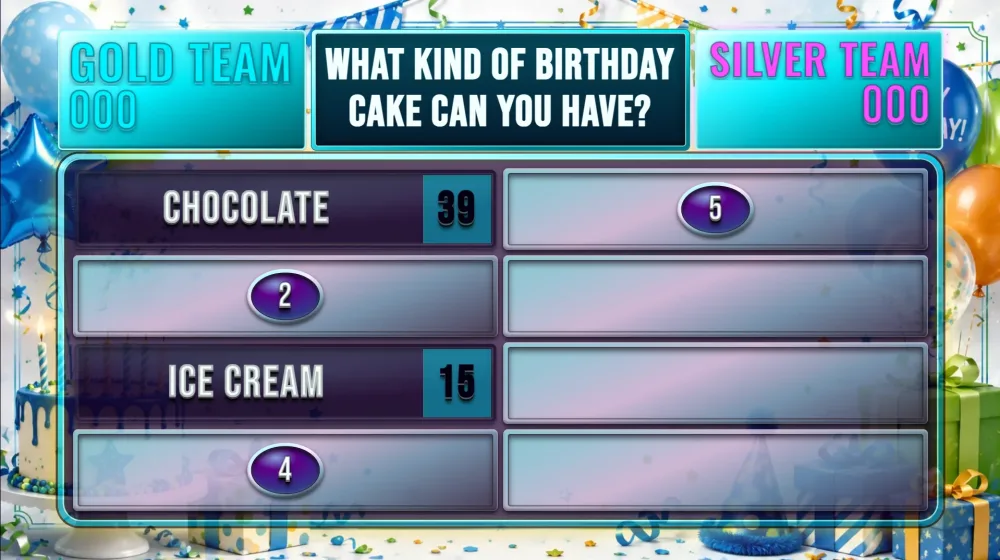
Classic game show about the guest of honour
Two teams, a board of answers and questions about the birthday guest. People guess what others think — not what is “objectively true”.
Teams can be family vs friends, old crew vs new, or mixed groups at the table.
How it runs
- The host splits guests into two teams.
- They read a survey question about the guest of honour.
- Team representatives hit the buzzers.
- First press tries to hit a popular answer.
- The team reveals the rest or loses the round.
- After a few rounds, the team with more points wins.
The best questions come from guests beforehand — anonymously, in a message or on paper. Then the answers are really about this person, not made up on the spot.
Sample questions
- What would they do with a million?
- What do they always say when they’re late?
- What do they order when they “eat anything”?
- What sits in their coat pocket all season?
- Which hobby did they start and drop after two weeks?
- What annoys them more than they admit?
- What sentence comes up most at their parties?
- What do guests remember from last year’s birthday?
Guests write, the guest of honour guesses
You collect answers from guests before the party. During the event the guest of honour (or their team) tries to guess what others wrote. The room usually laughs — the board doesn’t lie.
How it runs
- A few days earlier you send guests 5–8 questions.
- You turn the answers into a FamiliVersus board.
- At the party the guest of honour plays against the rest, or with one team.
- The host reveals what guests actually wrote.
- The further from the guest’s intuition, the louder the room.
Sample questions
- What superpower would you give them?
- What should they get — and what definitely not?
- What is their most “them” behaviour?
- Where will you see them in ten years?
Mixed generations at one table
Mixed-age teams — grandparent with grandchild, aunt with niece. Questions need answers both younger and older guests know. Then the table doesn’t split into “us” and “them”.
Skip questions that are only memes or only decades-old TV. A good mix: food, family habits, holidays, “what’s always on the table”.
A round made of memories
Guests split into two teams, ideally mixed by age. Collect questions ahead of time: one story from a person, several answers on the board. The points below are an illustration.
What do guests most often remember about the guest of honour?
- One story from years ago — 26 pts
- A favourite food — 20 pts
- Always being late — 16 pts
- A joke they repeat — 14 pts
- The first time you met — 12 pts
- A present they hid — 8 pts
Before the guests arrive
How is an adult birthday different from a kids party?
Here the game is about the guest of honour: memories and predictions. A kids party is for children, with questions written for their age.
Can I add my own questions?
Yes. On a free account you can prepare an unlimited library (categories, questions, up to 8 answers when saving) — including questions about a couple, a company or guests, by hand or with AI on Premium. In gameplay the first 3 questions from your library are available (alphabetical order); the rest locked; up to 8 answers on the board. Full library in gameplay — with Premium.
How long does setup take?
The first game takes about 5 minutes — from picking questions to connecting devices with a QR code.
Is the buzzer required?
No — you can host without a buzzer, but team duels are much more fun with one.